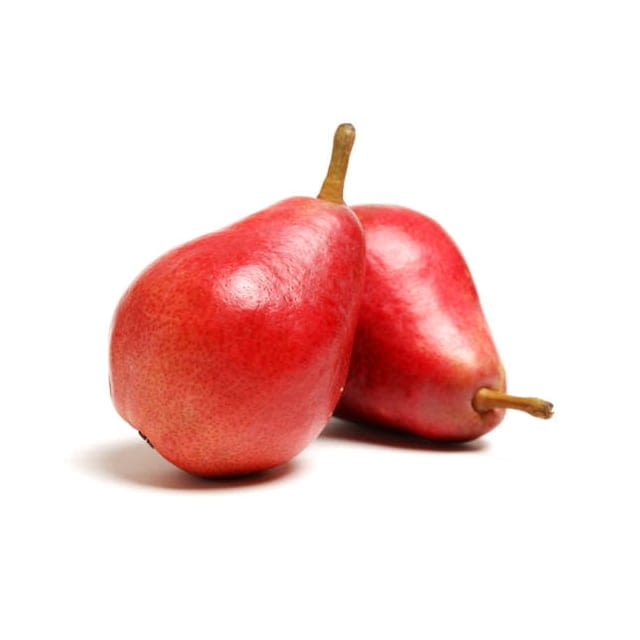
Red pears wholesale price — $38.00 / size 35–40 case
Supplier ref. 03925 · quoted October 16, 2026
Red pears are quoted at $38.00 / 35/40SZ case in the week of October 12, 2026. That is the lowest wholesale quote we recorded that week from the single New York distributor we track — not a market average, and not an official terminal quotation. The quote covers one 35/40SZ case, the unit the supplier invoices; we never divide it by a weight to publish a price per pound.
Price history
13 weekly quotes over 3M · lowest wholesale price observed, per 35/40SZ case
Over the last 12 months
Over the last 52 weekly quotes, red pears ranged from $24.00 to $48.00 per 35/40SZ case, averaging $33.89. Today's $38.00 / 35/40SZ case is above the 52-quote average of $33.89. The quote is down 13.6% from a month ago, when it stood at $44.00. The sharpest week-over-week move in the series is 50.0%, in the week of July 20, 2026 ($32.00 to $48.00). Across our series, red pears were cheapest in January (average $26.50) and dearest in August (average $44.80). That is one year of observation, not a seasonal rule.
- Low
- $24.00
- High
- $48.00
- Average
- $33.89
- Quotes
- 52
What is in the case
The supplier states no weight for the 35/40SZ pack, so we quote it as a pack and publish no price per pound for it. That is a limit of the source, and the reason our figure stays comparable from one week to the next: a per-pound price built on an assumed case weight moves whenever the assumption does.
Availability in New York
Available 12 months — Pacific Northwest storage crop, Argentina takes over in spring and summer
Where it comes from
In October, our reference lists three origins shipping pears into New York: Washington, Oregon and California, on trade calendars only. Sourcing is documented at the pears level and applied to this item.
- Washingtonyear-roundtrade calendar
- Oregonyear-roundtrade calendar
- CaliforniaJul, Aug, Sep, Oct, Nov, Dectrade calendar
- ArgentinaApr, May, Jun, Jul, Augtrade calendar
- South AfricaMayobserved for this category
- ChileMay, Augobserved for this category
- ChinaApr, May, Jun, Jul, Aug, Septrade calendar
Sourcing documented at category level (Pears) and applied to this product. Based on 10 sources · confidence: high
About Red pears
Pears are a storage fruit and our reference data documents the same logic as apples: a Pacific Northwest crop out of Washington and Oregon holds the year, Argentina takes over in spring and summer, and California adds fruit in the back half. Varieties do not substitute for one another in a kitchen — Bartlett ripens soft and fast, Bosc and Anjou hold their shape, and Asian pears are a different fruit for a different plate — so they are quoted as separate lines with no common price. The pack is a count size, and the same variety is often offered in a full carton and in a small carton for kitchens that will not turn a case.
Buying notes
Bartlett and Bosc are both quoted in a full count-size carton and in a small carton, and the small carton is the practical buy when pears are a garnish rather than a component. Pears arrive hard and finish in your walk-in, so order against a service date rather than a delivery date.
Frequently asked questions about Red pears
How much do red pears cost wholesale in New York?
Red pears are quoted at $38.00 / 35/40SZ case in the week of October 12, 2026, the lowest wholesale quote we recorded that week. The quote covers one 35/40SZ case, the unit the supplier invoices; we never divide it by a weight to publish a price per pound.
Are red pears expensive right now?
Against our own series, no reference price: over 52 weekly quotes red pears ranged from $24.00 to $48.00, averaging $33.89. Today's $38.00 / 35/40SZ case is above that average. That compares this item to its own history, not to another supplier.
When are red pears cheapest in New York?
In our series the monthly average was lowest in January ($26.50) and highest in August ($44.80). That is one year of weekly observation from one distributor, not a seasonal rule — a single cold season or a freight event can move a month.
Where do red pears come from?
In October, our reference lists three origins shipping pears into New York: Washington, Oregon and California, on trade calendars only. Sourcing is documented at the pears level and applied to this item.
What is in a case of red pears?
The supplier states no weight for the 35/40SZ pack, so we quote it as a pack and publish no price per pound for it. That is a limit of the source, and the reason our figure stays comparable from one week to the next: a per-pound price built on an assumed case weight moves whenever the assumption does.
How much has the price of red pears moved this year?
Up 18.8% over twelve months, from $32.00 to $38.00 / 35/40SZ case. The sharpest single week was 50.0%, in the week of July 20, 2026.
Are these the official Hunts Point prices?
No. $38.00 / 35/40SZ case is the lowest of 52 weekly quotes we recorded from one distributor serving New York. The USDA publishes the official New York terminal market quotations; we link to them from our methodology page.